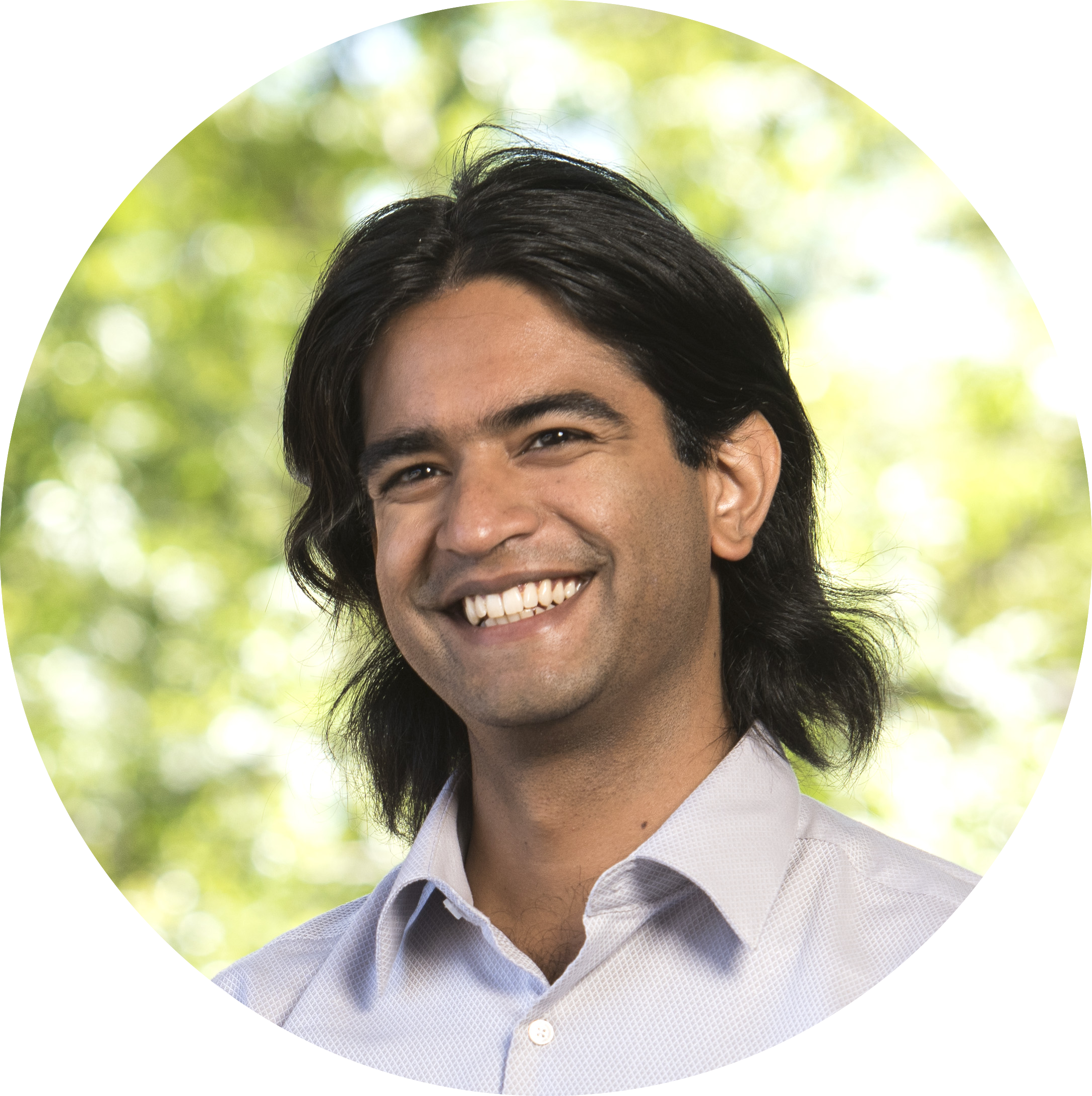
Mayank Daswani

Mayank Daswani

Member of Technical Staff, Microsoft AI

At Microsoft AI, I co-developed MAI-DxO, a multi-agent diagnostic system that matches specialist-level accuracy on complex NEJM cases. Across six years at DeepMind Health, Google Health Research, and Gemini, I took mammography screening AI through a regulatory submission, shipped post-training for factuality on Gemini 2.5, and led research showing that consumer hardware — a smartphone camera, a cheap radar — can replace clinical-grade cardiovascular sensing.

I hold a PhD in reinforcement learning from ANU under Marcus Hutter, where I worked on principled state abstraction and learned forgetting.

Full publication list on Google Scholar. Reach me on LinkedIn or at mayankdaswani@gmail.com.

Microsoft AI

Member of Technical Staff

I work on health AI within Microsoft AI, focused on using large language models for clinical applications. My most notable project is MAI-DxO (MAI Diagnostic Orchestrator), a model-agnostic orchestrator that simulates a panel of physicians to propose differential diagnoses and strategically select high-value, cost-effective diagnostic tests. When paired with OpenAI’s o3 model, MAI-DxO achieves 80% diagnostic accuracy on complex NEJM clinicopathological conference cases — four times higher than the 20% average of human clinicians on the same cases.

This work was published as Sequential Diagnosis with Language Models (arXiv, 2025) and introduced SDBench, an interactive benchmark for evaluating AI diagnostic agents through realistic sequential clinical encounters drawn from 304 consecutive NEJM cases.

Google / Google DeepMind

Senior Software Engineer / Senior Researcher

Nov 2024 – May 2025 · Gemini, Google DeepMind

For my last 6 months at Google I moved to the Gemini team, working on post-training for factuality for Gemini 2.5. Gemini 2.5 Pro achieves state-of-the-art performance on factuality benchmarks including SimpleQA and FACTS Grounding.

Jul 2019 – Nov 2024 · Google Health Research (originally joined as DeepMind Health)

I developed deep learning models that use physiological sensor data for clinical prediction. Key projects:

  • PPG-based cardiovascular risk prediction: Showed that photoplethysmography (PPG) signals from a simple fingertip device — combined with age, sex, and smoking status — can predict 10-year risk of major adverse cardiovascular events at a level non-inferior to traditional office-based screening. Published in PLOS Global Public Health (2024).
  • Radar-based heart rate monitoring: Demonstrated transfer learning between FMCW and IR-UWB radar types for contactless heart rate monitoring — the first such cross-radar transfer for vital sign measurement. Achieved MAE of 0.85 bpm with FMCW radar and a 25% MAE reduction on IR-UWB via transfer learning. Published on arXiv (2025).
QuintessenceLabs

Software Developer, Technical Lead

I worked on the qCrypt team at Qlabs. qCrypt is an Enterprise Key and Policy Management solution and the flagship product. Backing the software is a hardware platform that included (in 2019) the world’s fastest (1Gbit/s) quantum random number generator (QRNG), and a third-party Hardware Security Module (HSM).

I’ve worked on or have been the technical lead for a wide-range of product features and deliverables. Some notable projects include helping design and implement a multi-master replication system, third-party HSM integration, and improvements to the Backup/Restore functionality.

Australian National University

PhD Computer Science

I completed a PhD under the supervision of Marcus Hutter and Peter Sunehag. My doctoral thesis is titled Generic Reinforcement Learning beyond Small MDPs.

The broad theme of my work was to find practical ways of solving large partially observable environments using a technique known as Feature Reinforcement Learning (FRL), a framework within which an agent can automatically reduce a complex environment to a more tractable Markov Decision Process (MDP) by finding a map which aggregates similar histories into the states of an MDP. My focus was on empirical work targeted at practitioners in the field of general reinforcement learning, with theoretical results wherever necessary.

Australian National University

Bachelor of Computer Science (Honours), University Medal

I finished an undergraduate degree at the ANU in Computer Science. As part of this degree, I was able to craft a largely custom course through the Computer Science and Mathematics courses at the ANU.

My degree had an built-in honours year, I submitted my honours thesis in the field of reinforcement learning titled “An Empirical Evaluation of ΦMDP Agents”. For my performance through my degree, I received the prestigious University Medal .

Plots Unlock Time-Series Understanding in Multimodal Models

arXiv · Google Research Blog

Demonstrates that plotting health time-series as images for multimodal models dramatically outperforms text-based representations — up to 150% on consumer health tasks including fall detection, activity recognition, and readiness — with 90% reduction in API cost. No additional training required; standard multimodal models benefit directly.

Sequential Diagnosis with Language Models

arXiv

Introduces SDBench, an interactive benchmark for evaluating AI diagnostic agents through 304 NEJM clinicopathological cases. Also presents MAI-DxO, a diagnostic orchestrator that achieves 80% accuracy on complex clinical cases — 4x higher than the human clinician baseline — while managing cost-effectiveness via strategic test ordering.

Gemini 2.5: Pushing the Frontier with Advanced Reasoning, Multimodality, Long Context, and Next Generation Agentic Capabilities

arXiv

Technical report introducing the Gemini 2.X model family (Gemini 2.5 Pro and Flash). Gemini 2.5 Pro achieves state-of-the-art performance on factuality benchmarks including SimpleQA and FACTS Grounding. I contributed to the factuality work during my last six months at Google.

UWB Radar-based Heart Rate Monitoring: A Transfer Learning Approach

arXiv

First demonstration of transfer learning between FMCW and IR-UWB radar systems for vital sign monitoring. Using a novel 2D+1D ResNet architecture, achieves MAE of 0.85 bpm for heart rate with FMCW radar and a 25% MAE reduction on a small IR-UWB dataset via transfer learning, enabling accurate contactless heart rate monitoring via consumer electronics.

Predicting Cardiovascular Disease Risk using Photoplethysmography and Deep Learning

PLOS Global Public Health

Demonstrates that a deep learning model using PPG signals from a fingertip device — combined with age, sex, and smoking status — can predict 10-year risk of major adverse cardiovascular events (MACE) with C-statistic 71.1%, non-inferior to traditional office-based screening that requires blood pressure, BMI, and cholesterol measurements. A proof-of-concept for accessible CVD screening in resource-limited settings.

I’m an avid indoor boulderer. I also make electronic music — you can find some of it on SoundCloud.